Amit Shah inaugurates ‘Bharat Taxi’ in Gujarat
Speaking at the launch event, Shah said taxi services have now become an essential part of daily life of virtually every household in India.
The agreement is being viewed as a significant step towards implementing a water-sharing arrangement that had remained largely on paper for more than three decades.




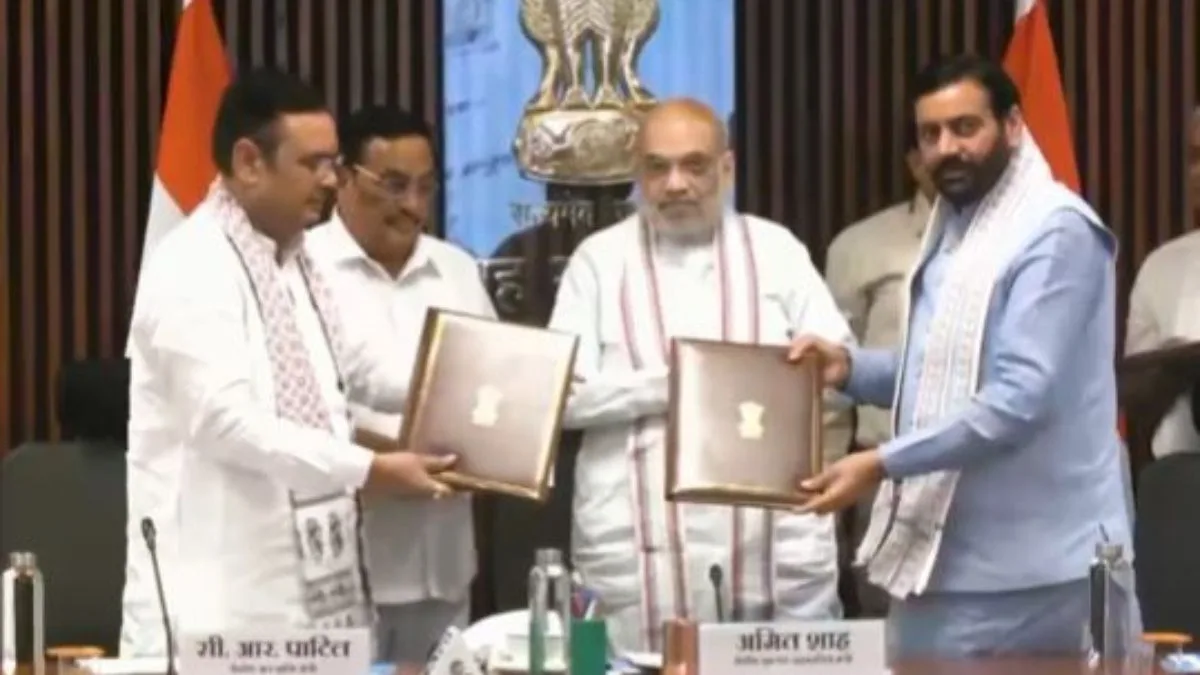
Image: X
Ending a decades-long stalemate over the sharing of Yamuna waters, Haryana and Rajasthan on Monday signed a Memorandum of Understanding (MoU) to operationalise water allocation under the 1994 Upper Yamuna River Board agreement. The pact was signed in the presence of Union Home Minister Amit Shah, Union Jal Shakti Minister C.R. Patil, Haryana Chief Minister Nayab Singh Saini and Rajasthan Chief Minister Bhajan Lal Sharma.
The agreement is being viewed as a significant step towards implementing a water-sharing arrangement that had remained largely on paper for more than three decades. Officials said the understanding is expected to ensure that Rajasthan finally receives the share of Yamuna water earmarked for it under the 1994 accord while strengthening inter-state cooperation on water management.
Advertisement
The two states have also agreed to develop the infrastructure required for transporting the allocated water. As part of the plan, an underground pipeline of nearly 300 kilometres will be laid from Hathnikund to Rajasthan at an estimated cost of around Rs 3,900 crore. The project will involve joint coordination on land acquisition, construction, monitoring and future operation of the pipeline.
Advertisement
आदरणीय केंद्रीय गृह एवं सहकारिता मंत्री श्री @AmitShah जी की अध्यक्षता में आज नई दिल्ली में हरियाणा और राजस्थान के बीच ऐतिहासिक जल समझौता (MOU) हुआ।
1994 के अपर यमुना रिवर बोर्ड समझौते के अनुसार राजस्थान को पानी उपलब्ध करवाया जाएगा तथा रेणुका, किशाऊ और लखवार बांध परियोजनाओं को… pic.twitter.com/IWWR8gwE5H
— Nayab Saini (@NayabSainiBJP) June 29, 2026
The Centre believes the agreement will also provide momentum to the long-pending Renuka, Kishau and Lakhwar dam projects. Once these projects become operational, they are expected to improve storage capacity in the Yamuna basin, increase the availability of drinking water and support irrigation requirements across the region.
Under the 1994 Upper Yamuna River Board formula, Haryana was allotted 40.6 per cent of the river’s waters, Uttar Pradesh 35.1 per cent, Rajasthan 10.4 per cent, Delhi 6.3 per cent and Himachal Pradesh 1.7 per cent. The newly signed MoU seeks to facilitate the delivery of Rajasthan’s allocated share under this existing framework.
Water experts, however, cautioned that Rajasthan’s supply would largely depend on seasonal surplus flows. According to them, the state is expected to receive around 33,379 cusecs of water during the monsoon period from July to October. They pointed out that the Yamuna generally carries surplus water for only a limited number of days during the rainy season, which could affect the regular availability of the allocated quantity.
The agreement has also sparked concerns in Haryana over its possible impact on groundwater resources. Experts associated with irrigation and river conservation said diverting surplus monsoon flows towards Rajasthan could reduce natural groundwater recharge in Yamunanagar, Karnal, Panipat, Sonipat, Faridabad and Palwal. They argued that the excess water, which earlier replenished aquifers in these districts, may no longer remain available after the diversion.
Some retired irrigation officials also questioned the move, stating that Haryana itself continues to face water stress in several regions. They suggested that a portion of the surplus water could have been utilised to strengthen water availability in the state’s southern districts instead of being diverted outside the state.
The agreement has also drawn political reactions. Opposition leaders maintained that Haryana should first secure its complete share of river waters from Punjab before implementing arrangements to transfer Yamuna water to Rajasthan. Some political leaders also revived their earlier objections to the 1994 water-sharing formula, arguing that it requires a fresh review in view of present-day water requirements.
In contrast, the development has been welcomed in Rajasthan, particularly in the water-scarce Shekhawati region, where public representatives and social organisations have long demanded access to Yamuna water. They believe the project will help reduce dependence on rapidly depleting groundwater reserves and provide a more sustainable source of water for domestic and agricultural needs.
Officials said the agreement reflects a coordinated effort by the Centre and the two state governments to resolve an inter-state water issue through consensus. They expressed hope that the arrangement would not only improve water distribution but also encourage better utilisation and conservation of river resources in the years ahead.
Advertisement